Do you have the bearing housing and the bearing – but do you have everything you need for installation?
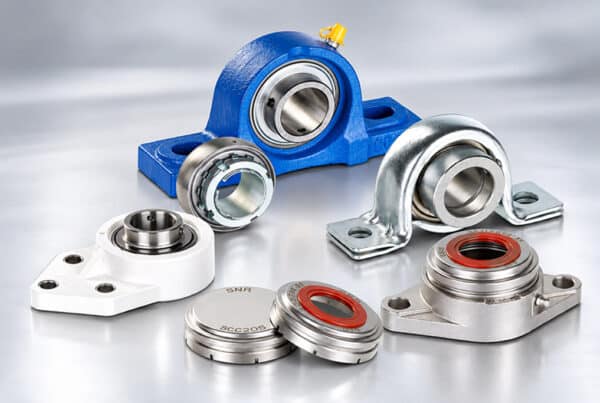
Split plummer block housings are a proven solution for bearing arrangements in many industrial and agricultural machines. Their design can make installation and maintenance easier, while allowing the bearing, sealing and locating solution to be selected according to the specific application.
However, this flexibility also means that a complete bearing arrangement does not necessarily consist of just a housing and a bearing. Depending on the design, an adapter sleeve, seals, locating rings and other related components may also be required.
If one of these components is missing, the problem may only become apparent once the machine has already been disassembled.
In our previous article, we introduced the NTN-SNR SRB KIT complete solutions. These kits provide compatible components for a specific maintenance task together in a single package.
But what if there is no suitable KIT available, or the bearing arrangement needs to be assembled individually?
Let’s take a look at when split plummer block housings are used and what you should consider before ordering the components.
Why Are Split Plummer Block Housings a Practical Choice?
One of the key advantages of SN and SNU split plummer block housings is their ease of installation. The upper part of the housing can be removed, which can make bearing installation, inspection and maintenance easier.
These housings are commonly used in conveyor systems, fans, drive systems, agricultural machinery and various types of industrial equipment.
Another advantage is that different bearing and sealing solutions can be selected to suit the specific application. However, this also means that the individual components need to be selected carefully to ensure compatibility.
What Do You Need to Install a Split Plummer Block Housing?
If you are repairing an existing bearing arrangement or building a new one, depending on the specific design, you may need:
- SN / SNU split plummer block housing
- suitable bearing
- adapter sleeve
- suitable seal
- FRB locating ring, if axial positioning of the bearing is required
Not every bearing arrangement requires all of the components listed above. The key is to determine exactly which components are required for the specific bearing arrangement before installation begins.
1. The Housing – The Part Number Can Be a Good Starting Point
When repairing an existing machine, the housing designation is often already known, for example SN506 or SNU506.
This can be a good starting point for identifying the correct components.
However, the housing part number alone does not necessarily define the complete bearing arrangement.
Among other things, you need to consider:
- which bearing will be fitted in the housing,
- the shaft design,
- whether an adapter sleeve is required,
- which sealing solution is needed,
- and whether the bearing needs to be axially located in the housing.
In other words, a known housing designation is the starting point of the search, not necessarily the end.
2. The Bearing – Size Is Not the Only Factor
Split plummer block housings can accommodate, among others, self-aligning ball bearings and spherical roller bearings.
If you know the bearing designation rather than the housing designation – for example 1206K, 2206K or 22206K – this can also be a starting point for identifying the related components.
However, when selecting a bearing, the application must be considered in addition to the main dimensions.
Important factors may include:
- the magnitude and direction of the load,
- rotational speed,
- shaft design,
- required internal clearance,
- lubrication,
- and the operating environment.
Therefore, even two bearings with identical or similar dimensions are not necessarily interchangeable.
3. Does the Bearing Have a Tapered Bore? You May Also Need an Adapter Sleeve
The suffixes and other designations in a bearing part number can provide important information.
The K designation indicates a tapered bore.
If this type of bearing is mounted on a cylindrical shaft, an adapter sleeve may be required depending on the arrangement. One example is the H206 adapter sleeve.
When selecting an adapter sleeve, compatibility with both the bearing and the shaft is essential.
The mounting procedure also requires careful attention.
With a tapered-bore bearing, the amount of drive-up on the sleeve affects the bearing’s radial internal clearance. This is particularly important for spherical roller bearings, so mounting and adjustment should always be carried out according to the bearing manufacturer’s instructions.
In other words, it is not enough to have the correct sleeve – the correct mounting procedure also matters.
4. Don’t Forget the Seal
A seal may seem like a secondary component, but it plays an important role in protecting the bearing arrangement.
Dust, moisture and other contaminants can enter the bearing arrangement, deteriorate the condition of the lubricant and contribute to premature bearing damage.
One of the advantages of split plummer block housings is that a sealing solution can be selected to suit the specific application.
The same type of seal may not necessarily be ideal for:
- dry and dusty environments,
- wet or heavily contaminated operating conditions,
- and general industrial applications.
Therefore, shaft diameter alone is not enough when selecting a seal.
The seal must be suitable for the housing, the shaft and the operating conditions.
Exact compatibility should always be checked against the technical data provided by the housing manufacturer.
5. Do You Need an FRB Locating Ring?
There is another component that is not required in every arrangement, but when it is needed, it should not be overlooked.
This is the locating ring.
In a shaft bearing arrangement, one bearing position is often designed as the locating position, while the other allows axial displacement – for example, to accommodate thermal expansion of the shaft.
If the bearing needs to be axially located in the housing, a suitable FRB locating ring can be used for the specific arrangement.
Examples of these designations include:
FRB12/180, FRB13/150 or FRB14/160.
The correct locating ring should always be selected according to the specific housing–bearing combination.
What Do You Often Discover Only During Installation?
You have the housing. You have the bearing.
The machine is disassembled, and then you discover that:
- the required adapter sleeve is missing,
- the correct seal is not available,
- a locating ring is required,
- or one of the selected components is not compatible with the others.
In such cases, even a relatively low-cost missing component can delay completion of the entire installation.
That is why it is worth checking not only the main component to be replaced, but the complete bearing arrangement before ordering.
Not Sure What You Need for Installation?
If you already know the part number of the bearing housing or the bearing, this can be a good starting point.
Not sure which bearing, adapter sleeve, seal or locating ring you need?
Ask our experts for assistance!
We can help you check the required components so that, whenever possible, you know exactly what you need for installation before placing your order.
Frequently Asked Questions
What is needed for a complete SN or SNU plummer block housing installation?
Depending on the arrangement, in addition to the housing you may need a suitable bearing, adapter sleeve, seal and, if required, an FRB locating ring. Not every bearing arrangement requires all of these components, so the specific housing–bearing combination should always be considered.
What type of bearing can be used in an SN or SNU plummer block housing?
Split plummer block housings can accommodate, among others, self-aligning ball bearings and spherical roller bearings. The correct bearing should be selected not only according to its dimensions, but also based on factors such as load, rotational speed, shaft design, internal clearance and operating conditions.
When is an adapter sleeve required?
An adapter sleeve may be required, for example, when a tapered-bore bearing – such as a bearing with a K designation – is mounted on a cylindrical shaft. The sleeve must be compatible with both the bearing and the shaft, and installation should always be carried out according to the bearing manufacturer’s instructions.
How do I choose the right seal for a split plummer block housing?
When selecting a seal, the operating environment should be considered in addition to the housing and shaft dimensions. Dusty, wet or heavily contaminated conditions may require different sealing solutions. Exact compatibility should always be checked against the technical data provided by the housing manufacturer.
When is an FRB locating ring required in a plummer block housing?
An FRB locating ring may be required when the bearing needs to be axially located within the housing. The correct locating ring should always be selected according to the specific housing–bearing combination.