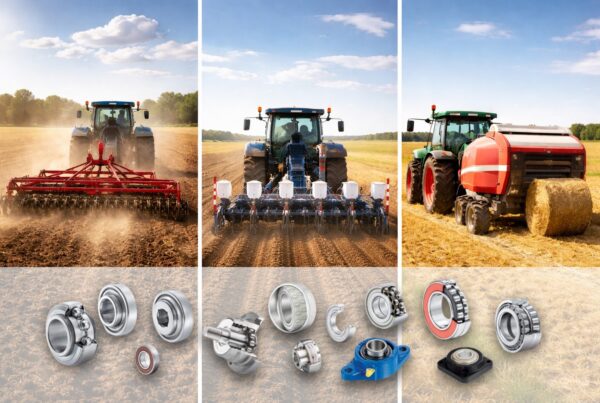
In industrial procurement, the real question whether a brand improves operational reliability, reduces downtime, and lowers total cost of ownership (TCO).
New here?
If you haven’t read the first article about the real drivers behind bearing total cost of ownership and downtime impact, it’s worth starting there to understand the full decision context.
What has changed in industrial supply chains?
Recent years have shown that cost does not only appear in price lists. Uncertain delivery times, temporary shortages, and supplier concentration all increase operational risk.
In this environment, suppliers gain value when they can:
- deliver quickly,
- maintain stable stock of critical sizes,
- cover multiple industrial applications.
This is no longer a convenience factor. It is an operational continuity factor.
What kind of supplier truly reduces total cost of ownership?
1. Availability and rapid delivery
A strategic supplier reduces operational risk without requiring premium pricing.
Immediate stock availability directly lowers:
- emergency procurement frequency,
- unplanned downtime,
- risk of temporary workaround solutions.
2. Broad portfolio across industries
If a partner supports industrial, agricultural, and automotive applications, it enables:
- supplier base rationalization,
- reduced administration,
- more consistent quality levels.
3. Stable quality between premium and standard tiers
Not every application requires premium-grade components. In many cases, reliable industrial-grade standard quality provides the best balance between lifespan and total cost.
Where does FBJ create measurable advantage?
In this context, FBJ is not simply another bearing brand. It represents a rapidly deployable, low-risk supplementary sourcing option.
Within Hungary, BEX can supply more than 3,500 FBJ bearing types within 24 hours.
In practice, this means:
- fewer forced temporary compromises,
- reduced emergency logistics cost,
- shorter production downtime.
At this point, the bearing is no longer just a component. It becomes a downtime-reduction tool.
What does this mean in a procurement decision?
Introducing FBJ does not necessarily replace existing suppliers. More often, it creates a second safety layer that:
- improves availability security,
- enables faster reaction in unexpected failures,
- reduces total operational risk and TCO.
This becomes especially relevant where even a single hour of downtime has significant financial impact.
Learn more about the FBJ bearing brand >>HERE<<
The real question is not whether to replace current suppliers
The strategic question is simpler:
Is there still hidden potential to improve availability, response speed, and total cost of ownership?
In many cases, a single well-chosen supplementary supplier is enough to shift procurement from price control toward operational risk reduction. And this is often where FBJ, supported by BEX’s rapid local delivery becomes a measurable business advantage.
Find FBJ bearings in our webshop or contact our colleagues if you have any questions.
If you would also like to see how FBJ can become not only an alternative, but also a complete industrial bearing supplier and portfolio partner, read part 3 of the series >> Industrial bearing supplier with a full portfolio: why FBJ deserves a place on your shortlist
For the previous part of our series, click >> The true cost of bearings: why total cost of ownership matters more than unit price?