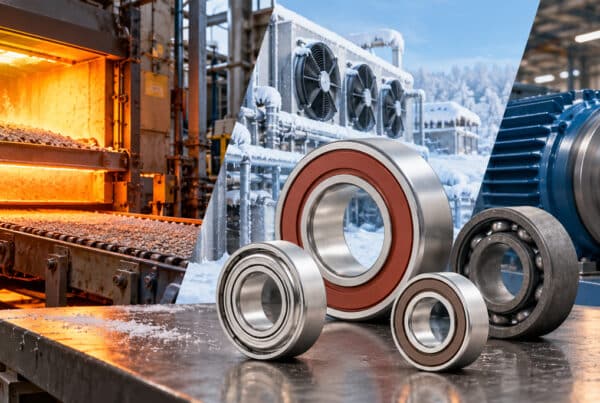
A bearing failure before the end of its expected service life can mean more than just replacing a component – it can also lead to unexpected machine downtime, production losses, and additional maintenance costs. That is why choosing the right bearing involves more than simply considering its dimensions and load capacity. Operating conditions are just as important.
The bearings used in a conveyor system, a vibrating screen, or a heavily loaded industrial drive face very different challenges. But which bearing solution is best suited to each application?
NTN–SNR spherical roller bearings are available in a wide range of designs, from standard industrial applications to demanding operating conditions. Let’s explore which type is best suited to each application!
5 Bearing Designs for 5 Different Application Requirements
1. Standard SRB – for General Industrial Applications
Standard open spherical roller bearings are designed to accommodate high radial loads while compensating for certain shaft misalignments.
When is it recommended? For general industrial machinery operating in relatively clean environments where proper lubrication and regular maintenance are ensured.

2. SSRB – Sealed Design for Protection Against Contamination
Dust and moisture entering a bearing can significantly affect its performance. SSRB bearings feature special nitrile rubber seals and are factory-greased, helping to protect the bearing’s internal components from contamination.
When is it recommended? For equipment exposed to contamination or applications where relubrication is difficult. The maximum operating temperature specified by the manufacturer for this design is 70 °C.

3. ROX – Enhanced Protection in Dusty Environments
In mines, quarries, and conveyor systems, contamination presents a significant challenge.
NTN–SNR ROX bearings feature a special double metal shield design that provides enhanced protection against external contaminants.
When is it recommended? For equipment operating in heavily contaminated and dusty industrial environments.

4. EF800 – for Vibrating Equipment
Continuous vibration and dynamic loads place particularly demanding stresses on bearings.
The EF800 series has been specifically developed for vibrating applications, featuring special tolerances and a machined solid brass cage.
When is it recommended? For vibrating screens and other vibrating machinery.

5. Spherical Roller Thrust Bearings – for High Axial Loads
In some industrial applications, axial loads rather than radial loads are the primary concern.
Spherical roller thrust bearings are designed to accommodate high axial loads.
When is it recommended? For applications such as presses, cranes, turbines, and heavy industrial machinery.

Higher Load Capacity, Longer Service Life
For its advanced spherical roller bearing designs, NTN–SNR highlights the following performance advantages based on specific manufacturer comparisons:
- Up to 24% higher dynamic load capacity
- Up to twice the service life under demanding operating conditions
- Up to 20% higher limiting speed
- Guaranteed steel dimensional stability up to 200 °C
These figures apply to specific bearing designs and manufacturer comparisons. The permissible operating temperature and actual performance must always be verified based on the technical specifications of the selected bearing and the application conditions.
Which Spherical Roller Bearing Is Right for Your Application?
When selecting a bearing, it is important to consider not only its dimensions and load capacity but also contamination, vibration, temperature, and lubrication conditions.
Choosing the right bearing design can contribute to more reliable operation, reduced maintenance requirements, and the prevention of unexpected machine downtime.
Looking for NTN–SNR spherical roller bearings?
At Bearing Kft., we can help you find the right solution for both standard and specialized industrial applications.
For more technical information, explore the NTN–SNR Spherical Roller Bearings Catalogue.
Frequently Asked Questions About Spherical Roller Bearings
What are spherical roller bearings used for?
Spherical roller bearings are designed to accommodate high radial loads while compensating for certain shaft misalignments. They are commonly used in industrial drives, conveyor systems, and heavy-duty machinery.
Which spherical roller bearings are recommended for dusty environments?
In dusty environments, NTN–SNR SSRB sealed bearings or ROX bearings with metal shields may be suitable solutions. SSRB bearings feature nitrile rubber seals, while ROX bearings use a special double metal shield design to help protect against contamination. The best choice depends on the operating conditions.
What is the difference between NTN–SNR SSRB and ROX bearings?
SSRB bearings are factory-greased spherical roller bearings equipped with nitrile rubber seals. ROX bearings feature a special double metal shield design developed for heavily contaminated environments. The two designs provide protection against contamination in different ways.
Which bearings are suitable for vibrating screens?
The NTN–SNR EF800 spherical roller bearing series is worth considering for vibrating screens and other vibrating machinery. These bearings feature special tolerances and a machined solid brass cage designed to withstand the demands of vibrating applications.
What temperatures can NTN–SNR spherical roller bearings withstand?
The permissible operating temperature depends on the bearing design and lubrication conditions. For the SSRB sealed design described here, the manufacturer specifies a maximum operating temperature of 70 °C. Certain NTN–SNR bearing designs offer guaranteed steel dimensional
stability up to 200 °C, but this does not mean that all bearings can operate at this temperature.
What factors should I consider when choosing a spherical roller bearing?
When selecting a spherical roller bearing, consider the magnitude and direction of the load, rotational speed, operating temperature, contamination levels, vibration, and lubrication and maintenance conditions. For specialized applications, technical consultation is recommended.