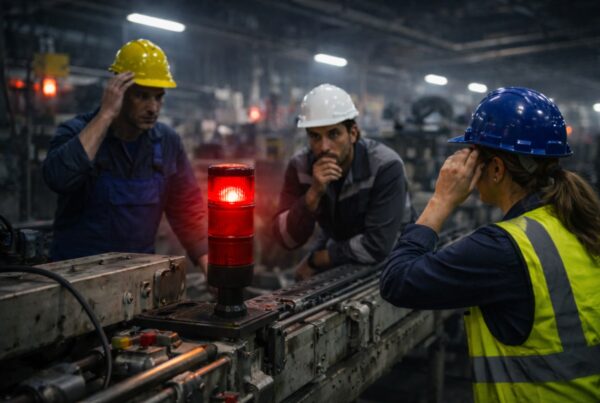
Most year-start failures do not happen in January. They only show up in January. And by the time we notice them, we are already paying for them during production.
Why is restarting machines after maintenance so critical?
Restarting machines after maintenance is not just switching production back on. It is the moment when every component receives load again after a longer standstill — often at the same time, without gradual adaptation.
During downtime there is no rotation, no lubrication film, no self-alignment. Loads remain concentrated on one point while the environment keeps working: humidity, dust and temperature changes. When the machine restarts, all of this immediately comes into motion.
This is why many post-maintenance failures do not occur at the moment of start-up, but during the first hours or days of operation.
What happens inside the machine during downtime, before restart?
Bearings during standstill
When a bearing is standing still, it is not in operating condition. The load is concentrated on one spot, lubrication does not circulate
and the lubrication film is interrupted. In humid or contaminated environments, surface changes can also develop.
The first revolutions during restart are critical. Friction and heat generation are higher, and without proper lubrication, damage can start very quickly. These are typical bearing issues that begin at restart but only become visible later.
Lubrication — when grease is there, but not where it should be
Lubrication problems usually do not start at restart, but during the standstill. Grease can separate, migrate, or simply not be present where it is needed for the first movement.
With manual lubrication points, relubrication is often missed during downtime. With automatic lubricators, cartridges may be empty or blocked, but because the machine was stopped, this remained unnoticed. As a result, restart often happens under partially or completely dry conditions.
Linear guides and linear systems
For linear systems, downtime is especially sensitive. Dust and contamination settle on the rails, lubrication does not refresh, and protective films break down. At the first movement, these surfaces are suddenly loaded. This is when sticking, unusual noise or uneven motion appears. These are not new problems — they are consequences of standstill.
Why are the first hours the most dangerous?
The first operating hours after restart are decisive. Damage that occurs here does not always stop the machine immediately, but it sets the direction for later failure.
Micro-damage can form on bearing surfaces, lubrication points can overheat, and wear can accelerate. These post-maintenance failures often appear with delay — exactly when stopping production is least acceptable.
This is why many unplanned downtimes can be traced back to a restart that seemed to be successful at the time.
Typical year-start issues that did not start in January
Common symptoms after restart include:
- unusual noise during the first shifts
- bearing overheating under load
- jerky or uneven linear motion
- leaking seals
- increasing vibration levels
What they have in common is that they are not new problems. The transition between standstill and restart brings them to the surface.
Restart is not an administrative task
In many plants, restart is treated as a checklist item. Power on, machine runs, production continues. But industrial machine restart is a maintenance event.
This is where experience matters: what we hear, what we feel, how the machine behaves under first load. Restarting machines after maintenance requires attention. Not necessarily more work, but a different kind of presence.
What can we learn from the first restart of the year?
The first restart of the year shows more than just what failed. It reveals where preparation was weak. Those who pay attention at restart are not only fixing problems — they are preventing them.
FAQ – About Machine Restart
What should be checked differently during the first restart?
During the first restart, performance is not the priority — behaviour is. Noise, temperature, vibration and smooth motion
indicate whether the standstill caused hidden issues.
A bearing is noisy at restart — should the machine be stopped immediately?
Not every noise means immediate failure, but persistent, increasing or unusual sounds are warning signs.
In such cases, lubrication and bearing condition should be checked.
Do automatic lubricators need attention before restart?
After long downtime, it is important to verify that the lubricator is working, contains grease or oil,
and that delivery is not blocked. Many restart failures come from overlooked lubricators.
How can you tell if a linear guide is just “waking up” or already damaged?
Slight initial resistance can occur, but sticking, uneven motion or noise is not normal and usually indicates lubrication
or contamination problems.
When does ignoring a restart issue cause problems later?
Rarely immediately. Problems often appear hours or days later as overheating, wear or unexpected failure.
Are all machines equally sensitive to restart?
No. High-load machines, bearing-intensive equipment and precision linear systems are especially sensitive,
while simpler, slow-moving machines usually tolerate downtime better.