
“We replace it every two months – and it still doesn’t last.”
You hear this quite often in contaminated industrial environments. Conveyor systems, clinker coolers, wood chip separators, automated warehouses, glass processing machines. Different industries, different machines – yet the pattern is the same.
On paper, the bearing is correct. The load rating is fine. The size fits. Still, it doesn’t last.
At this point, many start looking at the load again. In reality, that’s often not the main issue.
The problem is usually simpler.
Contamination is destroying the lubrication.
What actually happens inside the bearing?
In contaminated, abrasive environments, a bearing is exposed to more than just mechanical load. In the background, a slow but very consistent damage process begins.
- contamination enters the bearing,
- it mixes with the lubricant,
- the lubricant starts turning into a “grinding paste”,
- rolling elements and raceways begin to wear
This doesn’t happen overnight. First, you notice increased temperature. Then operation becomes noisier.
Eventually, it leads to seizure or unexpected bearing failure.
In most of these applications, the first question is not the load rating from the catalogue, but rather
how long the lubrication stays clean and effective.
The classic dead end: open or sealed?
From a maintenance perspective, this is a familiar dilemma.
Open bearing
Handles load and misalignment well, but contamination can easily reach the lubrication zone.
Typical issue: grease gets contaminated quickly.
Conventional sealed bearing
Works well in cleaner environments, but in highly abrasive conditions the seal itself can become the weak point.
Typical issue: rapid wear of the sealing lip.
This has already been experienced in many glass, cement and wood processing applications. Open designs don’t provide enough protection,
while traditional seals often cannot withstand abrasive environments for long.
A different approach: protection without friction
For these environments, alternative solutions have emerged where conventional rubber seals are not used.
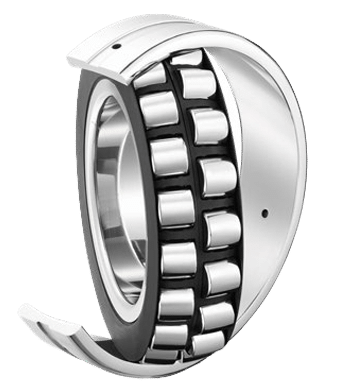
One example is the NTN SNR ROX spherical roller bearing, designed with a dual metal deflector concept.
The idea behind it is simple: increase uptime in contaminated, vibrating, heavy-duty environments, while keeping installation and handling as close as possible to standard solutions.
What does this mean in practice?
Longer service life
Based on manufacturer data and case studies, more than double service life can be achieved in contaminated environments compared to standard solutions.
Less maintenance
Better grease retention significantly reduces relubrication frequency, in some cases even by half.
Higher protection
Dual metal deflectors reduce contamination ingress and lubricant loss.
Better vibration resistance
The nitrided cage treatment and design provide improved performance under shock and vibration.
Easy installation
ISO dimensions and standard-like mounting logic mean no special installation procedures or tools are required.
More predictable operation
Fewer unexpected shutdowns, less frequent intervention, and more predictable maintenance cycles.
Real industrial examples
Different industries, same issue: the relationship between contamination and lubrication.
1. Quarry, conveyor belt tension drum
Fine limestone dust, moisture and mud reached the bearings. Even with premium solutions, maintenance was required every 2 months.
Result:
- service life increased by at least 5×
- grease retention improved 3×
- annual downtime reduced from 6 to 1
2. Cement industry, clinker cooler
Heavy contamination, high temperature, material spillage and high load. Many bearing positions, difficult access.
Annual maintenance resulted in approximately 15 days of downtime.
Result:
- service life increased by at least 2×
- maintenance time reduced by approx. half
- annual downtime reduced from 15 days to ~7.5 days
3. Automated vertical warehouse
Indoor, but contaminated environment. Difficult-to-access bearing locations, complex replacement and relubrication.
Result:
- no bearing failures over 2 years
- automatic lubrication system could be eliminated
4. Pulp and paper industry, wood chip separator
Heavily contaminated environment. Several previous solutions failed to provide stable operation.
Tested bearing: 22210EAW33ZZC3
Result:
- bearing remained in operation after 10 months
- previous solution caused 5 shutdowns in the same period
- estimated annual savings: >900,000 €
5. Glass industry, glass processing
Fine glass dust and moisture. Open designs did not provide protection, and conventional seals wore out quickly.
Result:
- service life increased by at least 6×
- number of shutdowns reduced from 6 to 0 over 2 years
What can we take from this?
Different industries, different machines, yet the same conclusion. In contaminated environments, bearing life is often not determined first by load capacity, but by how effectively contamination can be kept away from the lubrication zone.
If relubrication is frequent, access is difficult, or downtime is costly, then bearing selection is no longer just a component decision. It becomes an operational reliability decision.
When is this type of solution worth considering?
- in contaminated, abrasive environments,
- when frequent relubrication is required,
- in hard-to-access bearing locations,
- under vibration and shock load conditions,
- when downtime costs are high.
When is this not the best approach?
- in clean, dust-free environments,
- at very high speeds,
- in precision or high-accuracy applications.
This is important because the right selection always starts from the application, not from what worked somewhere else.
What should you look at in these cases?
In most cases, the real question is not which part number to choose, but:
- what type of contamination is present,
- how quickly lubrication degrades,
- how accessible the bearing location is,
- what the cost of downtime is,
- how often intervention is currently required.
If you answer these honestly, it quickly becomes clear whether you are dealing with a bearing problem,
or rather an environmental issue.
FAQ
How is this different from a conventional sealed bearing?
Does installation require machine modification?
Can relubrication intervals really be reduced?
Where does it pay off the fastest?
Is choosing a better grease enough?
Is this the right solution for every contaminated application?
Source: rox-snr.com