Linear guide systems are essential components of modern machinery and industrial automation. They provide precise, smooth, and reliable linear motion in a wide range of applications, including CNC machining centers, robotic cells, packaging machines, measuring equipment, and custom-built machinery.
However, selecting the right profile rail guide involves much more than choosing the correct rail size. Load capacity, accuracy requirements, carriage design, mounting accuracy, operating environment, and proper lubrication all play a crucial role in determining the system’s precision, rigidity, service life, and operational reliability.
In this article, we explain the key factors to consider when selecting a profile rail guide system and why proper sizing and correct installation are essential for achieving reliable, long-term performance.
Why Choose Profile Rail Guides?
High precision: Rolling elements running on precision raceways provide profile rail guides with excellent running and positioning accuracy, as well as outstanding repeatability. This is particularly important in applications such as CNC machining centers, robotic cells, automated production lines, and measuring equipment, where precise linear motion directly affects manufacturing quality.
High load capacity: Despite their compact design, profile rail guides offer high load-carrying capacity. When properly sized, they are capable of supporting radial and lateral loads, as well as various moment loads, making them suitable for demanding industrial applications.
Low rolling resistance: The rolling elements inside the carriage move along the guide rail’s precision raceways, resulting in significantly lower rolling resistance compared to conventional sliding guides. This makes profile rail guides particularly well suited for high-speed and high-dynamic applications.
Long service life: With proper sizing, correct installation, and regular lubrication, profile rail guides provide a long service life. Their expected lifespan is primarily influenced by operating load conditions, lubrication quality, contamination levels, environmental conditions, and installation accuracy.
What to Consider When Selecting a Profile Rail Guide
Load
Knowing only the mass of the moving load is not sufficient when selecting a profile rail guide. The following factors should also be taken into account:
- load magnitude,
- load direction,
- dynamic forces generated during acceleration and deceleration,
- moment loads,
- shock loads and vibration.
Improper sizing can significantly reduce the service life of the guide system and negatively affect its operating accuracy.
Accuracy Requirements
Not every application requires the same level of accuracy. A material handling system has different precision requirements than a CNC machining center or a precision measuring machine. Profile rail guides are available in various accuracy classes. Since the classification may vary by manufacturer, the selection should always be based on the technical documentation of the specific product.
Carriage Design
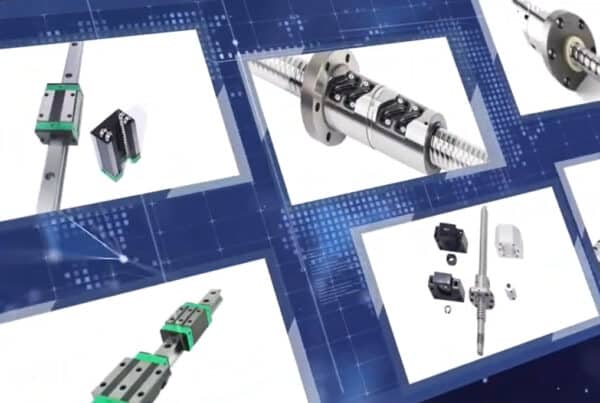
Selecting the appropriate carriage design has a significant impact on the system’s rigidity, load capacity, and installation flexibility. Our product range includes several carriage configurations, such as:
- standard,
- long,
- narrow,
- flanged.
The optimal carriage design depends on the applied loads, the available installation space, and the required rigidity.
Number and Arrangement of Carriages
The guide rail and carriages should always be considered as a complete system during the design process. The same rail size can provide different load capacities depending on:
- the number of carriages used,
- the spacing between the carriages,
- whether one or two parallel guide rails are used,
- the distance between the guide rails,
- the location of the load’s center of gravity.
In many cases, the correct arrangement of the guide system is more important than simply selecting a larger rail size.
Operating Environment
In dusty, wet, or chip-contaminated environments, it is recommended to use carriages equipped with appropriate sealing systems and to pay particular attention to regular relubrication. In corrosive environments, stainless steel or corrosion-resistant surface-treated versions may also be required.
Mounting Accuracy
The proper performance of a profile rail guide depends on a precisely machined, flat, and sufficiently rigid mounting surface.
Flatness or parallelism deviations of the mounting surfaces, as well as uneven support, can introduce unwanted internal stresses into the guide system, which may:
- increase rolling resistance,
- reduce running accuracy,
- accelerate wear,
- shorten service life.
Profile rail guides can compensate for mounting errors only to a limited extent. Therefore, it is essential to follow the manufacturer’s installation and alignment requirements to ensure reliable operation and maximum service life.
Why Is Proper Lubrication Important?
Lubrication is one of the most important maintenance tasks for profile rail guides.
Using the correct lubricant and following the recommended relubrication intervals:
- reduces wear,
- minimizes rolling resistance,
- protects the rolling elements and raceways,
- contributes to a longer service life.
In applications involving heavy loads or contaminated environments, following the manufacturer’s lubrication recommendations is particularly important.
Automatic Lubrication Makes Maintenance Even Easier
If multiple profile rail guides require regular lubrication, implementing an automatic lubrication system is a practical solution. Simatec automatic lubrication solutions can also be used for the lubrication points of profile rail guides with the appropriate adapters. They are particularly beneficial for automated production lines, CNC machines, and applications with difficult-to-access lubrication points.
Where Are Profile Rail Guides Used?
Profile rail guides are widely used across a broad range of industrial applications, including:
- CNC machining centers,
- robotic cells,
- automated production lines,
- packaging machines,
- measuring and inspection equipment,
- woodworking, metalworking, and plastics processing machinery,
- custom-built machines,
- medical equipment.
Did You Know?
The profile rails available from Lintek can be cut to your required length and delivered ready for installation. This reduces installation time, simplifies assembly, and eliminates the need for on-site cutting.
Looking for a Profile Rail Guide?
Selecting the right profile rail guide involves much more than choosing the rail size. The carriage type, load capacity, accuracy requirements, and operating environment all play a key role in determining the best solution for your application.
At lintek.hu, you can choose from a wide range of profile rail guides, carriages, and complete linear motion systems in various sizes and configurations. If you need assistance selecting the right solution, our experts are happy to help. Upon request, we can also supply profile rails cut to your required length and delivered ready for installation.
FAQ About Profile Rail Guides
What is a profile rail guide?
A profile rail guide is a linear motion system consisting of a profile rail and a guide carriage that travels along it. Rolling elements inside the carriage provide precise, smooth, and low-friction linear motion.
What applications are profile rail guides used for?
Profile rail guides are widely used in CNC machines, robotic systems, automated production lines, packaging machinery, measuring equipment, and custom-built machines.
What types of loads can a profile rail guide handle?
A properly selected profile rail guide can withstand radial, lateral, and moment loads. The actual load capacity depends on the rail size, guide carriage type, system configuration, and operating conditions.
How do I choose the right profile rail and guide carriage?
Selection should be based on the magnitude and direction of the load, the required accuracy, travel speed, available installation space, and operating environment. Choosing the appropriate carriage design and accuracy class is also essential.
Why is proper lubrication important for profile rail guides?
Proper lubrication reduces friction and wear, protects the raceways, and helps ensure smooth operation and long service life. Relubrication intervals should always be determined according to the application, load conditions, and operating environment.
Can profile rails be cut to custom lengths?
Yes. The profile rails available at Lintek.hu can be cut to your required length and supplied ready for installation. This eliminates the need for on-site cutting, helping to reduce installation time and minimize additional work.
Are profile rails and guide carriages from different manufacturers interchangeable?
Not always. Although some products may have similar dimensions, hole spacing, accuracy classes, preload, raceway geometry, and mounting dimensions can vary between manufacturers. Always verify the technical specifications before replacing components.