Does the same bearing keep failing?
Are unexpected downtimes becoming more frequent?
In most cases, the issue isn’t the quality of the bearing – it’s the selection.
Choosing the right bearing is not just a technical decision, but a business one as well. The right choice can:
- increase machine lifespan
- reduce downtime
- optimize maintenance costs
In this article, we present the most common types of bearings and help you decide which one is the best fit for your application.
Why is choosing the right bearing critical?
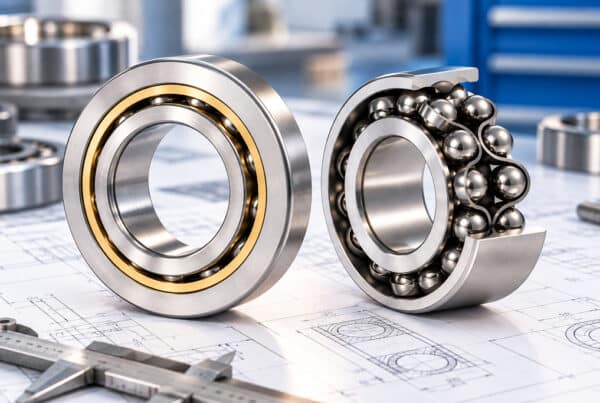
Bearings are designed to reduce friction and safely handle loads (radial, axial, or combined).
Selecting the wrong type can lead to:
- overheating
- accelerated wear
- premature failure
- costly downtime
1. Deep Groove Ball Bearings – when speed matters
Deep groove ball bearings are among the most commonly used types, especially in high-speed applications.
Advantages:
- low friction
- suitable for high rotational speeds
- versatile use across many applications
Typical applications:
- electric motors
- fans
- pumps
What to consider?
For heavy loads, this may not be the best choice – in such cases, a roller bearing is usually more suitable.

2. Spherical Roller Bearings – designed for extreme loads
Spherical roller bearings are specifically designed to handle heavy loads and operate reliably in harsh working conditions.
Advantages:
- high load-carrying capacity
- self-aligning capability (compensates for shaft misalignment)
- long service life
Typical applications:
- mining
- steel industry
- conveyor systems
When is it ideal?
When loads are high and perfect alignment cannot be guaranteed.

3. Plain Bearings – simple yet robust solution
Plain bearings have a simpler design with fewer components, making them well-suited for dirty and demanding environments.
Advantages:
- simple construction
- high load capacity
- good resistance to contamination
Typical applications:
- construction machinery
- agricultural equipment
- automotive industry
Practical advantage:
They perform reliably in conditions where rolling bearings would fail quickly.

4. Needle Roller Bearings – when space is limited
Needle roller bearings can support high radial loads while requiring minimal installation space.
Advantages:
- compact design
- high load capacity in a small space
Typical applications:
- gearboxes
- automotive systems
- industrial drives
When to choose?
When installation space is limited but load capacity requirements are high.

5. Tapered Roller Bearings – for combined loads
Tapered roller bearings are designed to handle both radial and axial loads simultaneously.
Advantages:
- supports combined loads
- high stability
- precise guidance
Typical applications:
- wheel hubs
- gearboxes
- heavy machinery
Important:
Proper adjustment and preload are critical for optimal performance.

6. Self-Aligning Ball Bearings – when alignment isn’t perfect
Self-aligning ball bearings can compensate for angular misalignment between the shaft and the housing.
Advantages:
- self-aligning capability
- reduced sensitivity to shaft misalignment
- longer service life under non-ideal conditions
Typical applications:
- conveyor systems
- woodworking machinery
- agricultural equipment
When is it ideal?
When installation is not perfectly aligned or shaft deflection/misalignment may occur.

How to choose the right bearing?
When selecting the right bearing, always consider the following factors:
- type of load (radial, axial, or combined)
- rotational speed
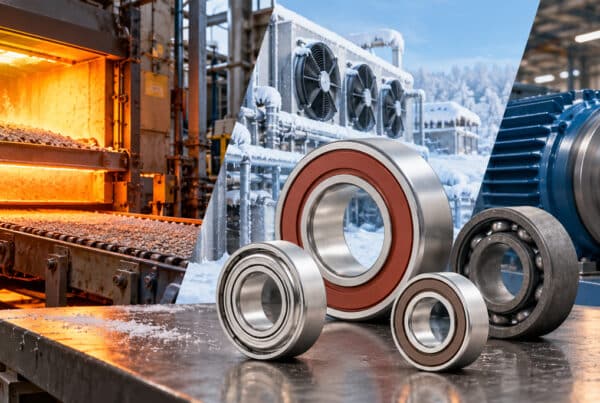
- environmental conditions (dust, moisture, temperature)
- available installation space
Quick selection guide:
- high speed → ball bearing
- heavy load → roller bearing
- limited space → needle roller bearing
- combined load → tapered roller bearing
- misalignment → self-aligning bearing
Choosing a bearing is not a routine decision—it is a critical factor in machine performance. Most failures are not due to manufacturing defects, but rather the result of incorrect bearing selection.
By choosing the right bearing, you can significantly reduce:
- downtime
- maintenance costs
- the number of unexpected failures
Not sure which bearing to choose?
Selecting the right bearing can be more complex than it seems. If you need more information or are looking for a solution for a specific application, it’s worth consulting an expert.
The team at Bearing Kft. is here to help you find the optimal bearing solution for your needs.
FAQ
Which type of bearing is best for high-speed applications?
For high-speed applications, ball bearings are generally the best choice, as they provide smooth and reliable operation with low friction. Typical applications include electric motors, fans, and pumps.
Which bearing should be used for heavy loads?
For heavy loads, roller bearings—such as spherical roller bearings or tapered roller bearings—are recommended. Due to their larger contact surface, they can handle high radial and combined loads more effectively.
What is the difference between ball bearings and roller bearings?
The main difference lies in the rolling elements. Ball bearings use balls, resulting in lower friction and suitability for higher speeds. Roller bearings use cylindrical or other shaped rollers, allowing them to carry heavier loads.
When should needle roller bearings be used?
Needle roller bearings are ideal when installation space is limited but high radial load capacity is required. They are commonly used in gearboxes, automotive systems, and compact industrial drives.
What are self-aligning ball bearings used for?
Self-aligning ball bearings can compensate for angular misalignment between the shaft and the housing. This makes them especially useful in applications where shaft deflection, vibration, or installation inaccuracies may occur.
How can you tell if a bearing needs to be replaced?
Signs of bearing failure include unusual noise, increased vibration, overheating, irregular rotation, or intermittent stoppages. If any of these symptoms occur, the equipment should be inspected as soon as possible.
What factors should be considered when selecting a bearing?
When selecting a bearing, consider the type and magnitude of the load, rotational speed, environmental conditions (contamination, temperature, moisture), lubrication requirements, and available installation space.
In which industries are bearings most commonly used?
Bearings are used across nearly all industries, including manufacturing, agriculture, mining, automotive, food processing, construction, and material handling. The appropriate type always depends on the specific application and operating conditions.